




Table of Contents
ToggleChancellorsville is one of Crusader Kings III’s most compelling historical scenarios, drawing players into one of the American Civil War’s pivotal moments. Whether you’re a seasoned CK3 veteran or stepping into the 1863 bookmark for the first time, mastering this scenario requires understanding the complex interplay between territorial control, faction dynamics, and military positioning. This guide breaks down everything a player needs to know to achieve victory in Chancellorsville, from character selection through endgame strategy. We’ll cover faction strengths, terrain advantages, resource optimization, and the tactical mistakes that derail most playthroughs, so you can avoid them and dominate the battlefield.
Key Takeaways
- Chancellorsville demands immediate tactical decisions where territorial control and faction positioning determine victory, unlike slower medieval CK3 scenarios.
- Terrain mastery is critical—wooded areas provide +25% defense bonuses and reduce cavalry effectiveness by 35%, forcing players to choose battlegrounds strategically.
- Union forces must leverage their 40% numerical advantage through attrition and defensive positioning, while Confederate forces need to achieve a knockout blow within 30-40 days before Union numbers compound.
- Supply line control determines survival; armies disconnected from supply hubs lose morale and disband, making logistics as important as military tactics on the Chancellorsville battlefield.
- Concentrating forces on 2-3 critical zones (Rappahannock crossing, Chancellorsville, the Wilderness) beats spreading thin across the map, and players should avoid predictable faction strategies to catch opponents off-guard.
- Success requires rapid adaptation—switching unit compositions based on terrain, managing reinforcement speed, and knowing when to retreat and reposition rather than engaging every available battle.
What Makes Chancellorsville Unique in Gaming Scenarios
Chancellorsville stands apart from other CK3 scenarios because it strips away the medieval feudalism most players know and throws them into a tightly focused, historically grounded conflict. Unlike the sprawling maps of earlier bookmarks, Chancellorsville compresses the action into a specific region with clear objectives and asymmetrical starting positions.
The scenario forces players to make decisions that feel consequential immediately. You can’t meander through diplomatic marriages and slow tech progression, every decision ripples through a dynamic military situation. The map layout punishes indecision and rewards aggressive early positioning. Most importantly, Chancellorsville demands that players understand logistics, terrain, and coordinated unit tactics in ways that casual playthroughs of the base game don’t require.
What makes it even more compelling is the historical authenticity woven into the mechanics. The game doesn’t just recreate the battle on a whim: it models the actual advantages each side possessed, including the Confederate army’s superior cavalry and the Union’s numerical superiority. This creates a scenario where victory isn’t predetermined, it’s genuinely contested, which is exactly what keeps players coming back.
Historical Context and Map Overview
The Real Battle and Its Gaming Adaptation
The Battle of Chancellorsville, fought May 1–6, 1863, was a Confederate victory even though significant Union numerical advantage. General Robert E. Lee’s daring decision to split his forces and flank the Union right proved devastatingly effective, though it cost him General Thomas “Stonewall” Jackson through friendly fire and subsequent wounds. CK3’s scenario captures the essence of this moment, the Union holds stronger initial positions and outnumber the Confederacy, but the South possesses superior leadership and mobility.
The game translates this into mechanical terms. Union forces begin with more men-at-arms and defensive positions, giving them a grinding advantage in attrition warfare. Confederate forces have better commanders with higher martial scores and access to cavalry-focused tactics that reward aggressive maneuvering. The scenario winner isn’t determined by who can outlast whom in a siege, it’s determined by who can execute their faction’s intended strategy before the opponent adapts.
Key Locations and Strategic Zones
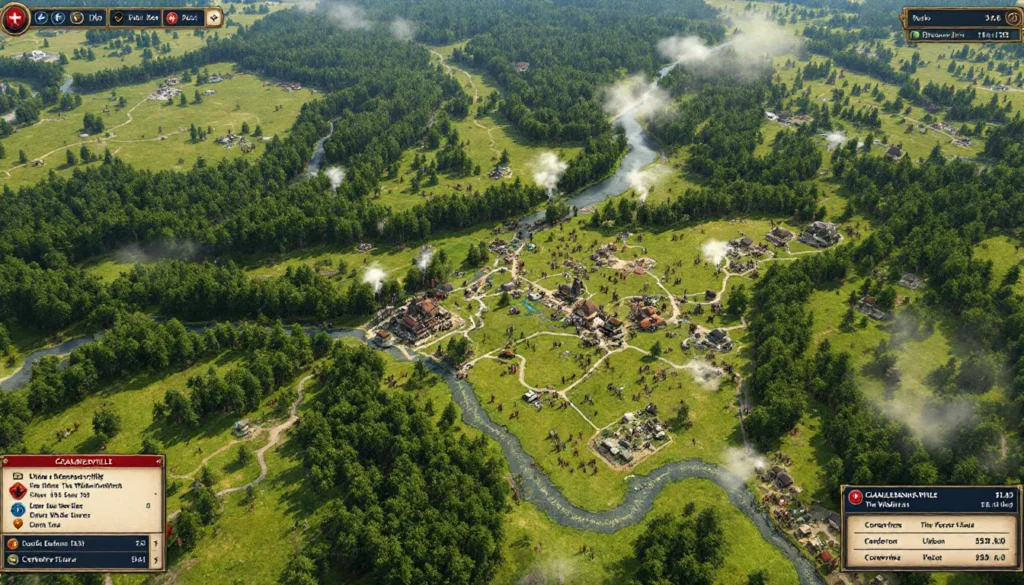
The Chancellorsville map divides into five critical zones: the Rappahannock River crossing to the north, Chancellorsville proper in the center, the wooded terrain (“The Wilderness”) to the west, the Union right flank near Ely’s Ford, and the Confederate supply lines running south.
Control of the Rappahannock crossing is essential early because it determines who can reinforce whom. If the Union loses it, Confederate forces can press their advantage and split Union attention. The Wilderness acts as a force multiplier for whoever fights there, defenders gain bonuses, and cavalry charges lose effectiveness in dense terrain. Chancellorsville itself is the scenario’s economic center: whoever controls it gains resources and prestige.
Most matches are won or lost based on who secures two of these three locations within the first 20 days: the Rappahannock crossing, Chancellorsville, and the forest positions to the west. Spreading your forces to hold all three is typically a losing proposition because you lack the numbers to defend everywhere at full strength.
Faction Analysis and Character Selection
Union Forces: Strengths and Vulnerabilities
Union forces start with approximately 18,000 men-at-arms split across three primary armies, giving them a 40% numerical advantage. This seems overwhelming until you realize that numbers alone don’t guarantee victory in Chancellorsville, positioning and concentration do.
Union strengths:
- Larger standing army provides attrition advantage in prolonged engagements
- Defensive starting positions offer fortification bonuses on day one
- Multiple commanders means you can split forces across the map without crippling any single army
- Supply lines to the north ensure steady reinforcements if logistics aren’t disrupted
Union vulnerabilities:
- Slow cavalry makes the Union vulnerable to flank attacks and cavalry charges
- Dispersed starting positions mean the Union can’t easily concentrate force for a knockout blow
- Reliance on defensive play means aggressive Confederate tactics often catch Union forces off-guard
- Poor flanking options due to the Rappahannock forcing Union movement into predictable routes
If you’re playing Union, your advantage is grinding down Confederate forces through attrition and controlling supply lines. Your weakness is that Confederate forces, if well-commanded, can punch through your dispersed armies and win before your numbers matter. Successful Union play requires patience and coordination, something that’s harder than just smashing armies together.
Essential Military Strategies and Tactics
Terrain Utilization and Positioning
Terrain in Chancellorsville isn’t decoration, it’s the primary determinant of tactical outcomes. The wooded areas provide +25% defense to defenders and reduce cavalry effectiveness by 35%. Meanwhile, open terrain near the river crossings favors cavalry and ranged attacks, reducing close-combat bonuses.
Optimal positioning strategies by faction:
For Confederate forces, draw Union armies into the Wilderness as much as possible. Plant forces on ridges and in forest clearings where your cavalry can operate but Union artillery loses effectiveness. Force the Union to attack uphill and through dense terrain, where their numerical advantage becomes a liability.
For Union forces, keep battles on open terrain near crossings and supply lines. Use terrain to slow Confederate cavalry charges: position men-at-arms behind fortified positions that negate cavalry flanking bonuses. Never allow Confederate forces to choose the ground, if they’re retreating into the Wilderness, let them. Your advantage is forcing them into the open where your numbers dominate.
One critical detail: the Rappahannock River creates a physical barrier that affects troop movement. Crossing it takes additional time, and armies that cross become vulnerable during the transition. Control of crossing points isn’t just symbolic, it gates entire armies from reinforcing elsewhere. Confederate victory often hinges on preventing Union reinforcements from crossing north of the river.
Troop Composition and Unit Management
CK3’s Chancellorsville scenario uses simplified unit types compared to medieval warfare. You’re working with:
- Infantry (men-at-arms): Your backbone. Higher health, lower damage, excellent in formations. Confederate forces start with fewer but higher-quality infantry thanks to better commanders.
- Cavalry: The wild card. Devastating on open terrain, nearly useless in forests. Confederate cavalry is faster and hits harder: Union cavalry is slower but more numerous.
- Archers (ranged units): Effective at range, vulnerable in melee. Both factions have them, but positioning matters more than quantity.
- Artillery: Limited in this scenario but present. Effective against fortified positions and massed formations.
Optimal compositions:
Confederate (10,000 troops total): 40% cavalry, 50% infantry, 10% ranged. Leverage mobility and high-quality leadership to win through aggression and flank attacks. Your army is built for striking fast and breaking Union formations before they stabilize.
Union (18,000 troops total): 20% cavalry, 65% infantry, 15% ranged. You’re building a wall. Heavy infantry with ranged support creates formations that are hard to break. Use cavalry to prevent Confederate cavalry from flanking, not to attack cavalry head-on.
Don’t treat unit composition as static. If you’re defending a forest position, shift toward heavier infantry and ranged units. If you’re pursuing a retreating enemy through open ground, increase cavalry ratio. The scenario rewards flexibility, armies that don’t adapt to changing conditions get punished fast.
Advanced Gameplay Tips for Competitive Success
Economy and Resource Management
Unlike other CK3 scenarios, Chancellorsville doesn’t have a deep economic layer, you can’t build improvements or manage county development over years. Instead, the economy is about supply lines and reinforcement speed. This is actually more important than you’d think.
Every army consumes supplies based on its size and location. Armies far from supply centers lose morale and suffer attrition. Confederate forces, starting from the south, need to maintain supply lines running north toward Chancellorsville. Union forces, starting dispersed, need to ensure armies don’t get cut off from the main supply hub.
Resource management strategy:
- Secure the central supply zone early. Chancellorsville itself acts as a logistics hub: control it and you gain a steady supply bonus that lets larger armies operate longer without reinforcement.
- Don’t overextend supply lines. If you push an army five provinces deep into enemy territory without a supply connection, it’ll start losing cohesion within 15 days.
- Use supply denial as a weapon. Confederate forces can win by cutting Union supply lines and forcing armies to retreat or starve. Union forces can win by occupying supply nodes and forcing Confederate units to disband from lack of supplies.
- Reinforce faster than your opponent can damage. If you control more supply zones than your opponent, your armies heal and grow faster. Eventually, you’ll have a numbers advantage your opponent can’t overcome.
The hidden resource is time. Chancellorsville scenarios last roughly 60 days. The longer the match goes, the more Union’s numerical advantage compounds. Confederate success depends on achieving a knockout blow within 30-40 days. Union success depends on simply surviving long enough for Confederate resources to deplete.
Diplomacy and Alliance Building
Diplomacy in Chancellorsville is… limited. You’re not negotiating with foreign powers or arranging marriages. But, minor diplomatic actions still matter.
You can demand surrender from weakened enemy forces, sometimes without fighting. A Confederate army reduced to 30% strength might surrender rather than fight, saving you casualties. Similarly, you can negotiate temporary truces if you’re facing total defeat, which can reset the scenario or trigger alternate victory conditions depending on server settings.
The bigger “diplomacy” is understanding when to negotiate with the terrain and your opponent’s positioning rather than their formal diplomacy. If the enemy is positioned to encircle you, sometimes the diplomatic move is a strategic retreat that preserves your force and lets you fight another day. If you’ve already won the critical battles and hold Chancellorsville plus the Rappahannock crossing, the diplomatic move is pushing for quick enemy surrender rather than grinding out a full military elimination.
One note: check your server’s victory conditions before the match starts. Some servers play for military elimination (kill every enemy army), others play for territorial control (hold X% of the map), and others use historical victory (recreate Lee’s actual flanking maneuver). Your strategy changes dramatically based on these conditions. In military elimination, you fight to the bitter end. In territorial control, you can win by holding key zones while your opponent exhausts themselves attacking. In historical victory, you’re chasing a specific strategic objective rather than pure victory through conquest.
Common Mistakes and How to Avoid Them
Mistake 1: Spreading forces too thin. New players try to hold the entire map at once. Chancellorsville punishes this. Concentrate your forces on 2–3 critical zones and ignore the rest. The player who has local superiority at the critical point wins the engagement. Winning three key battles decisively beats winning six meaningless skirmishes.
Mistake 2: Ignoring terrain bonuses. Charging uphill into forest-defended positions into the Wilderness is a union player’s worst mistake. Conversely, allowing Confederate forces to retreat into terrain where you can’t leverage your numbers is surrendering your advantage. Study the map before battle. Know where defensive terrain lies and whether you’re attacking or defending it.
Mistake 3: Splitting armies inefficiently. You need armies large enough to fight independently. An army of 1,500 troops can’t win an engagement against 3,000 troops, no matter the terrain or morale. Union can get away with slightly smaller armies due to numbers: Confederate forces absolutely need consolidated, strong armies or they get picked apart.
Mistake 4: Forgetting about supply lines. You can have a huge army, but if it’s not connected to a supply zone, it melts away. Confederate forces especially should track their supply line at all times. One Union player taking Chancellorsville can starve an entire Confederate army if that army isn’t connected to another supply hub.
Mistake 5: Playing predictably. Your opponent knows what you want to do. If you’re Union, they expect you to turtle up and defend. If you’re Confederate, they expect you to attack aggressively. The best players break these expectations. Union occasionally launching aggressive cavalry strikes catches Confederate scouts off-guard. Confederate playing defensively for the first 10 days then attacking when Union expects it creates chaos.
Mistake 6: Engaging every battle. Not every fight is winnable, and not every fight matters. Sometimes the correct play is retreat, reposition, and attack the weakened enemy from a better angle later. Throwing armies at enemies in bad terrain or unfavorable matchups just feeds your opponent corpses.
Conclusion
Chancellorsville in Crusader Kings III is a masterclass in asymmetrical scenario design. The Union has numbers but poor positioning: the Confederacy has mobility and better leaders but faces inevitable numerical pressure. Victory belongs to whichever side executes their faction’s intended strategy first and adapts when the enemy doesn’t comply.
The core principles, concentrate force, leverage terrain, manage supply lines, and make decisions quickly, apply to any Chancellorsville playstyle. Whether you’re playing Union seeking a grinding attrition victory or Confederate hunting a knockout blow, these fundamentals separate players who win consistently from those who lose repeatedly.
The scenario shifts slightly as the CK3 community discovers new tactics and the balance evolves through patches, so check recent patch notes if you’re playing on the latest version. That said, these strategies have held up across multiple patches because they’re based on the scenario’s underlying design rather than exploitable mechanics.
Load up your next Chancellorsville match, remember that terrain is destiny and time is your enemy, and turn one of history’s pivotal moments into your personal victory.