

Table of Contents
ToggleBattlefield 3 redefined what multiplayer FPS combat could be, and at the heart of that revolution was a deceptively simple mechanic: cover. Unlike games where you could sprint across open ground and tank headshots, Battlefield 3 demanded respect for positioning, line of sight, and smart use of your environment. Whether you’re ducking behind a crate in Operation Métro or using a blown-out building wall in Seine Crossing, knowing how to use cover separates players who die every five seconds from those stacking kills and controlling entire sections of the map. The cover system in Battlefield 3 wasn’t just window dressing, it fundamentally shaped how teams moved, communicated, and won engagements. This guide breaks down everything you need to know to weaponize cover like a veteran, from basic mechanics to advanced psychology that’ll have enemies second-guessing every peek you take.
Key Takeaways
- Effective Battlefield 3 cover use separates skilled players from novices by rewarding positioning and gamesense over raw aim, compressing the skill gap through smart environmental control.
- Mastering peek-and-fire mechanics, movement between cover points, and rotation timing are essential survival techniques that prevent predictability and punish tunnel vision.
- Dynamic destruction of cover forces constant adaptation in matches, requiring players to identify both primary positions and secondary fallback routes before protection deteriorates.
- Map-specific Battlefield 3 cover strategies differ dramatically between urban and open environments, demanding distinct approaches to positioning, engagement distance, and suppressive fire tactics.
- Class-specific cover strategies maximize effectiveness: Assaults push through cover chains aggressively, Supports maintain wide suppression zones, and Recons prioritize elevated sightlines over physical protection.
- Advanced cover psychology involves reading enemy movement patterns, avoiding predictable positions, and balancing cover dependency with controlled aggression to maintain engagement advantages.
Understanding The Fundamentals Of Cover In Battlefield 3
How The Cover Mechanic Works
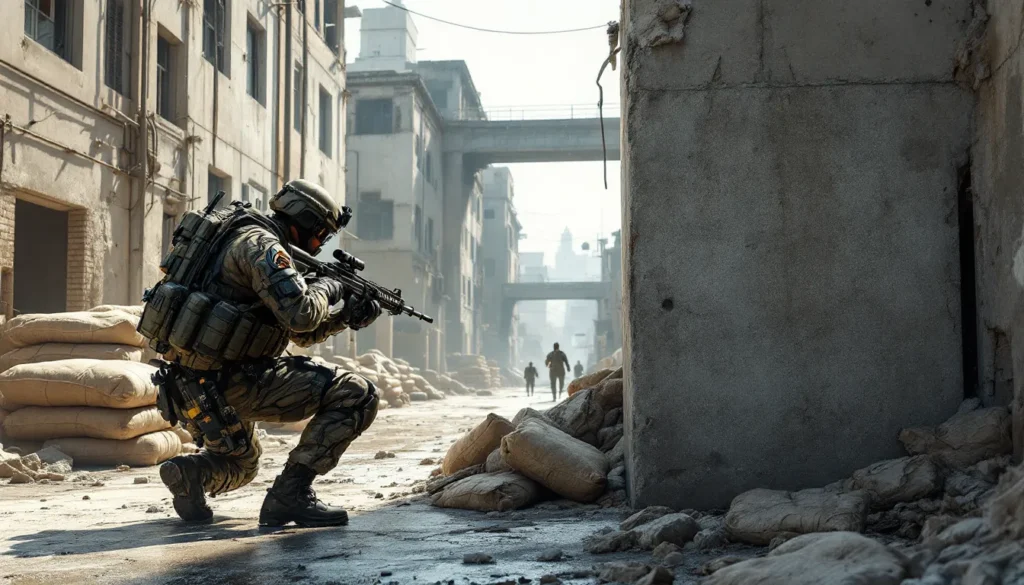
Battlefield 3’s cover system operates on a straightforward principle: if a solid object is between you and incoming fire, bullets won’t pass through. That’s it. But the execution matters enormously. Unlike some games that force you into scripted cover animations, Battlefield 3 lets you move fluidly between cover points. You’re not locked in place, you’re choosing when to expose yourself, for how long, and at what angle.
Your character’s height relative to cover determines what you can shoot over and what can shoot you. A waist-high sandbag wall is different from a chest-high concrete barrier, which is different from full-body concealment inside a building. The game’s hit detection is tight enough that you can’t just clip through edges, you have to actually position yourself correctly. This is why angles matter so much. An enemy holding cover five meters away might have a perfect line on your head if you’re even slightly exposed, while a different position behind the same barrier leaves them nothing to aim at.
Range also affects cover effectiveness. At close quarters, cover becomes a hard stop to aggressive pushes. At longer distances, even thin cover provides meaningful protection because recoil and spread make precision harder for your opponent. Understanding where the effective cover line is, the point at which an enemy’s angle no longer lets them see you, is foundational to everything else in this guide.
Why Cover Matters In Multiplayer Combat
Battlefield 3 multiplayer isn’t about who has the steadiest aim in a vacuum: it’s about who controls space and forces engagement on their terms. Cover does that. A team using cover effectively can hold ground against superior numbers because each player extends the other’s protection, creates overlapping fields of fire, and makes flanking exponentially more risky for the enemy.
Consider TTK (time to kill) in Battlefield 3. Most weapons kill in 4-7 bullets at medium range. That’s roughly 0.4 to 0.7 seconds of sustained accurate fire. A player in full, smart cover forcing you to aim carefully can weather your opening burst while they return fire from behind protection. The player without cover? Dead in under a second. Cover compresses the skill gap by reducing the raw aim advantage of a twitch player, but it massively rewards gamesense and positioning. You don’t need to be a flick-shot artist if you’re already pre-aimed on a corner and the enemy has to expose themselves to engage you.
Beyond individual duels, cover mechanics shape team play. Squads that move cover-to-cover, leapfrog defensive positions, and understand sightline control dominate pub matches and competitive play. Teams that run across open ground without utilization get decimated by suppressive fire and coordinated crossfires. This is why spawning next to cover, immediately orienting toward nearby hardpoints, and communicating positions matters even in casual play.
Types Of Cover Locations And Structures
Destructible Environments And Dynamic Cover
Battlefield 3’s destructible environments are a defining feature, and they completely change how cover strategy evolves during a round. Early in a match, a wooden fence or flimsy wall provides solid concealment. Five minutes later, after gunfire and explosives have shredded it, that same spot is a death trap. This dynamic forces constant adaptation.
Destructible cover falls into rough categories. Wooden structures and thin walls can be destroyed by sustained rifle fire or a few explosions, they’re temporary and unreliable for long-term positioning. Concrete barriers, metal reinforced walls, and sandbag stacks take more punishment and hold longer. Vehicles and large debris can also serve as cover, though staying near vehicles that might be destroyed (or worse, using the vehicle yourself and making it a target) adds risk.
The psychological shift when cover deteriorates is real. An engineer watching their sandbagged position get slowly dismantled knows they need to relocate. Knowing this, smart players pre-position secondary cover or fall-back routes. In Rush mode especially, defenders who rely on pre-match cover without planning destruction will collapse as their protection erodes. The best defensive lines mix destructible elements (which buy time and slow pushes) with indestructible cover (walls, buildings, terrain) that remains viable as the round progresses.
Static Cover Objects And Strategic Positions
Not all cover gets destroyed. Buildings, concrete bunkers, rock outcrops, and permanent structures remain throughout the round. These form the backbone of map control. A warehouse in Grand Bazaar, a chapel in Damavand Peak, or the central building on Noshar Canals, these are anchor points. Controlling them means controlling extended sight lines and creating zones where enemies must navigate with extreme caution.
Static cover varies by type. Internal structures like buildings offer 360-degree protection but limit visibility and create windows for enemies to collapse on you from multiple angles. External structures like sandbag emplacements or rubble walls provide directional cover, excellent for holding one angle, vulnerable from others. Terrain-based cover, dips, ridges, vehicle wrecks, can be subtle but invaluable because enemies might not immediately recognize them as protection.
The best static positions aren’t just covered in isolation: they have depth. A good defensive spot includes immediate cover (what you hide behind right now), secondary cover (where you fall back to if pushed), and a route to tertiary positions (where the squad regroups if the position becomes untenable). Players who only know the first position get caught in the open during the transition and die predictable deaths. Veterans have mental maps of these chains across every map.
Urban Versus Open-Map Cover Strategies
Urban maps like Operation Métro, Grand Bazaar, and Damavand Peak feature tight corridors, multiple building levels, and abundant hard cover. The density of objects creates cover everywhere, which paradoxically makes positioning more about understanding sightlines and choke points than raw concealment. In these maps, being in cover is almost a given, the question is whether your cover lets you control key passages, bomb sites, or objectives.
Open maps like Caspian Border and Kharg Island flip the script. Sight lines stretch hundreds of meters. Cover is sparse, spread out, and occupying good positions means longer engagements and more emphasis on weapon accuracy and recoil control. A player in an excellent open-map position might hold an objective from 80+ meters away, relying on sniper rifles or scoped assault rifles. Urban maps compress these distances, you’re trading fire at 20-40 meters, often in tight quarters where reaction time and understanding peeker’s advantage dominates.
The strategy shifts accordingly. Urban pushes are faster, more reactive, and lean into suppressive fire and coordinated rushing. Open-map play rewards patience, scanning horizons, identifying enemy positions, and establishing dominance through superior positioning and long-range accuracy. A squad that plays urban maps as if they’re open (too spread out, too slow) gets picked apart by snipers. A squad that plays open maps as if they’re urban (clumped up, slow repositioning) gets surrounded and flanked. Map literacy, knowing which cover type dominates and planning accordingly, separates good players from those who apply the same tactics everywhere and wonder why they lose.
Essential Cover Techniques For Survivability
Peek-And-Fire Mechanics
The peek is the foundational offensive technique in Battlefield 3. It’s simple: move out from behind cover just enough to aim and fire, then immediately retreat before your opponent can return accurate fire. The goal is to catch them off-guard, land hits, and get back to safety. Done well, it’s almost impossible to punish. Done poorly, you’re moving into their aim point and dying to their return fire.
Effective peeking starts with understanding your peek angle. If you’re behind a wall, the optimal peek point is at the edge, you expose the minimum body surface area while maximizing your own sight line on the target. Wide, center-of-object peeks expose your torso and head simultaneously: those are compromises used when you need better visibility or when the cover is too thin for edge exploitation.
Timing matters as much as angle. A predictable peek (same spot every time, or intervals that enemies can anticipate) becomes a free-fire target zone for your opponent. Mixing up your peek points, high, low, left edge, right edge, keeps enemies honest. Some players chain multiple rapid peeks to suppress enemies while teammates flank: others slow-peek, extracting information while staying mostly covered. In competitive play, experienced players read peek patterns and pre-aim accordingly, turning the tables on careless opponents.
Distance affects peek viability. At close range (under 15 meters), peeking a skilled opponent is risky because their reaction window is tiny and their spread is tight, one burst can end you. At medium distance (20-40 meters), peeking becomes stronger because recoil and spread give you more forgiveness. At range (60+ meters), a good peek into a scoped opponent is suicide. The farther you are, the more you need to establish sight control and maintain cover most of the time, peeking deliberately to reposition or suppress rather than to trade shots.
Movement Between Cover Points
Staying in static cover too long makes you predictable. Smart players identify two or three nearby cover points and rotate between them, keeping enemies guessing about your current position. The transition between cover points is where you’re most vulnerable. Moving too slowly invites enemy focus fire. Moving too fast makes you miss threats. Finding the balance, moving deliberately but with purpose, is a core survival skill.
The best movement routes are those enemies won’t naturally watch. Exposed routes that require sprinting across open ground? Avoided unless it’s a coordinated push where teammates suppress enemies. Routes that hug building edges, use terrain undulation, or take advantage of blind spots from enemy positions? Those are viable. In populated areas, moving during objective chaos (bomb planting, flag capping) when enemy attention is divided is safer than attempting movement when enemies are actively scanning for you.
Squad-based movement is stronger than solo movement. While one player rotates, teammates maintain cover and suppress enemies, creating windows for safe transitions. “Leapfrog” tactics, where one element moves while the other covers, then they reverse roles, allow squads to advance through contested territory systematically. Solo players rotating positions must accept more risk and often succeed by moving only when enemy attention is elsewhere, or by moving so fast that precision targeting becomes unreliable. This is why good players develop spatial awareness of where enemies are likely concentrated before committing to movement.
Countering Flanks And Predictable Positions
Every position has a weakness. A corner cover spot that’s perfect for holding an approach becomes a death box if an enemy flanks from behind. Recognizing your vulnerability and proactively mitigating it separates survivors from victims. This might mean setting up secondary back-cover, stationing a teammate to watch your rear, or actively rotating positions before the enemy can exploit the flank.
Predictable positions get punished. If you’ve been in the same spot for 30 seconds, enemies have your range and are setting up. Rotate. If the team noticed you’re holding an objective corner every round, that corner becomes a grenade funnel. Mix it up. The mentality shift needed here is simple: you’re not holding cover, you’re controlling space. If staying in one spot no longer controls space effectively, it’s not a good position anymore.
Flanking threats require awareness and communication. A callout, “contact, three on the left flank”, gives the team time to reposition. Without information, defenders get surrounded. This is why solo queue players die to flanks more often: they can’t rely on anyone warning them. In team play, rotating out of compromised positions before they become true kill zones is standard. In pubs, dying to predictable flanks is incredibly common because positional awareness and communication are limited.
Map-Specific Cover Strategies For Popular Game Modes
Conquest Mode Cover Tactics
Conquest mode in Battlefield 3 spreads objectives across the map, creating multiple contested zones. Cover strategy in Conquest revolves around securing and holding key positions that dominate flag locations and sight lines between them. The layout forces distributed focus. You’re not defending one bomb site: you’re managing multiple territories simultaneously.
Effective Conquest positioning identifies cover that overlooks multiple flags or that sits on logical supply routes between them. On Caspian Border, the central raised position offers sightlines toward multiple flags and is inherently strong. On Grand Bazaar, controlling the central building gives teams access to overlapping sightlines on surrounding objectives. The cover itself matters less than what it controls. A mediocre position that watches three flag approaches beats excellent cover that’s irrelevant to objective flow.
Team rotations in Conquest mean positions shift emphasis constantly. A cover point that’s essential when defending A flag becomes less critical if the fighting shifts to C. Good squads anticipate enemy movements and position themselves on likely rotational paths, setting ambushes where enemies expect to move freely between objectives. This forward positioning, staying ahead of the actual fighting, is what separates coordinated teams from groups running to live combat every spawn.
Team Deathmatch Cover Placement
Team Deathmatch strips away objectives, making raw gunfight dominance the focus. Cover strategy becomes pure positioning and control. The best positions in TDM are those that offer multiple engagement angles, clear sightlines on common player paths, and protection from counter-ambush. Rather than rotating extensively, TDM teams hold strong ground and force enemies into disadvantageous engagements.
Cover quality matters more in TDM because engagement density is higher. Weak positions get overwhelmed quickly. A smart TDM squad identifies the strongest cover clusters (usually central map locations), occupies them, and locks down that territory. Enemy teams either challenge directly (dangerous for them) or avoid the position and lose map control. Smart enemies identify rotational routes around these dominant positions, creating secondary zones of contested cover.
Solo players in TDM should identify cover that’s strong enough to defend you one-versus-multiple, but not so conspicuous that you become a marked target. Popular power positions in TDM are known and expected: predictably holding them gets you surrounded. A slight offset, cover 15 meters from the obvious position, but still part of the area’s general dominance, often yields better solo results because enemies focus on expected locations while you punish them from secondary cover.
Rush Mode Defensive And Offensive Positions
Rush mode condenses the map into a linear series of objectives. Cover strategy is fundamentally different because both teams know exactly where the next battle will be. Defenders prepare positions around bomb sites with depth and overlapping coverage. Attackers organize pushes using cover-to-cover movement and suppressive fire to advance toward increasingly restrictive objectives.
Defensive cover in Rush must account for the attacker’s force direction. A position that’s perfect for defending a bomb site when the assault comes from the south becomes useless if they breach from the east. The best defensive setups use indestructible cover forming a perimeter around the bomb, sandbags, bunkers, buildings, with depth layers where squads can fall back if one position is overrun. Engineers with C4 defending positions set explosive traps near secondary cover lines, forcing attackers to advance through devastating kill zones or lose momentum.
Attacking positions in Rush focus on suppression cover, points where teams can lay down fire to advance teammates closer to the bomb. Cover here isn’t about long-term holding: it’s about establishing foothold positions from which to push further. Attackers work through cover chains toward the objective, with each position closer than the last. The aggression escalates systematically. Defensive cover is reactionary: it’s wherever the attacker currently threatens. This asymmetry is why Rush teams struggle if defenders initially control better ground, the defenders are defending stronger positions, while attackers must advance through harder terrain. As attackers get closer, this flips: eventually, close-range cover favors the aggressive push.
Advanced Positioning And Cover Psychology
Reading Enemy Movement And Cover Predictability
Experienced players develop the ability to predict where enemies will position themselves based on map layout, game state, and human psychology. Certain cover is “obvious.” New players gravitate toward prominent hardpoints and obvious defensive positions. Veterans know these zones are contested, predictable, and often heavily focused fire. Reading the enemy means anticipating not just where they’ll be, but whether that position is currently held by a skilled defender or a predictable opponent.
Movement patterns tell stories. If an enemy squad keeps rotating toward the same secondary objective, they’re either defending a predictable route or rushing to reinforce a threatened flag. Noticing this pattern creates opportunities for ambushes at the next expected position. If defenders keep abandoning a position after a few seconds, the position itself might be untenable (bad sightlines, poor depth, etc.) rather than the defenders being weak. Occupying it exposes you to the same vulnerability.
Cover choice reveals player skill level. A new player might camp a good cover position for the entire round. An intermediate player will recognize threats and rotate. An advanced player pre-rotates before threats materialize, keeping themselves ahead of predictability. Recognizing these patterns helps you adjust. Against campy players, flanking works. Against rotation-heavy players, timing your pushes to catch them mid-transition works. Against pre-rotating veterans, you need superior positioning and often numbers to win engagements.
Cover Dependency And Overexposure Risks
Relying too heavily on cover creates vulnerability. A player who never leaves cover becomes locked into reactive gameplay: they respond to what the enemy does instead of controlling what the enemy can do. Also, tight cover dependency limits your effective range and forces predictable engagement patterns. Enemies learn where you hide and exploit it.
The flip side is overexposure, a player overconfident in their aim or reaction time who doesn’t use cover adequately. In Battlefield 3, nearly every good player can destroy an exposed opponent at most ranges. TTK is simply too fast. The best players balance coverage with aggression. They use cover to control engagements but move when cover becomes a liability. They peek and reposition. They don’t hide passively, but they’re not reckless.
Team dependency on shared cover creates cascading vulnerabilities. If a squad bunkers down in a single strong position, a well-placed grenade, RPG, or flanking route demolishes them all simultaneously. Distributed positioning, squads spread across multiple cover points with overlapping coverage but not co-located, creates redundancy. One position being overrun doesn’t lose the entire squad: survivors still have defensive depth. But, players also need to balance distribution with cohesion. A squad spread too thin can’t support each other and loses firefights against concentrated enemies. The skill is finding the threshold: close enough to support, distant enough for redundancy.
Class-Based Cover Strategies
Assault And Support Classes In Coverage
Assault players leverage cover for aggressive pushing. Equipped with rifle-and-close-range optimized loadouts (and health packs for self-sustenance), Assaults use cover as a base for forward pushes. The optimal Assault strategy involves moving through cover chains closer to objectives, establishing presence, and forcing team responses. An Assault holding mid-range cover can suppress enemies, allowing Support teammates to flank or Recons to reposition for sniping angles.
Assault-specific positioning often focuses on cover that offers exit paths toward enemy territory. Dead-end cover is less valuable for Assaults because their strength is in forward momentum. A good Assault position controls a corridor or approach that enemies must navigate, and when enemy response becomes too hot, the Assault rotates forward (not backward) toward the next objective. This rhythm, establish presence, push when enemies respond, rotate toward objective, defines aggressive Assault play.
Support players use cover to maintain sustained engagement. With LMGs (light machine guns) dealing suppressive fire and healing teammates, Support positions should enable overlapping coverage of multiple angles. Cover that lets a Support LMG suppress multiple approaches while teammates shelter and return fire is ideal. Support doesn’t need perfect cover for peeking: they benefit from cover that protects their heavy, slow weapon platform while enabling wide suppression zones.
Support-specific cover utilizes width and open sightlines more than depth. A sandbag wall running perpendicular to common enemy routes is stronger for Support than a tall corner cover, because the wall lets them traverse and suppress across a wide arc. Also, Support positioned near teammates maximizes healing utility, so cover clusters, multiple positions close together but not perfectly co-located, work well for Support squads.
Engineer And Recon Positioning
Engineers bring vehicle-fighting capability and explosives, fundamentally changing cover strategy near vehicles and objective areas. An Engineer’s optimal positioning near cover often includes sight lines on vehicles and routes where enemies might cluster for explosives. Mines near cover entrances, C4 prepared for detonation when enemies advance through chokepoints, these require positioning that balances covering fire with ability utility.
Engineer cover should account for their role’s weakness: they’re not optimized for medium-range firefights in the way Assaults are. Excellent Engineer positioning accepts shorter engagements and leverages explosives to create advantages enemies can’t overcome through superior gunplay. Holding tight cover near objective sites, setting booby-traps, and detonating explosives when enemies concentrate requires fewer angles and more tactical precision.
Recon players leverage cover for sniping or spotting from distance. Their positioning emphasizes elevated sightlines, long-range cover, and routes providing unobstructed views of contested territory. A Recon positioned on high cover overlooking an objective can suppress entire squads with sniper fire, preventing pushes. The cover itself is often secondary to the sightline it provides: a mediocre physical protection position with excellent visibility becomes strong for Recon.
Recon-specific strategy includes finding positions enemies won’t immediately suspect. The obvious sniper perch gets overwhelmed quickly if enemies identify it. Slightly offset positions, not the obvious tower, but the nearby ledge, offer similar sight control while staying off enemies’ mental maps of likely positions. Also, Recon benefits from cover providing escape routes. A sniper position with only one exit becomes a trap if enemies flank it. Multiple approaches or fast descent routes let Recons reposition before being surrounded, maintaining engagement indefinitely rather than dying to a single flank route.
Common Cover Mistakes And How To Avoid Them
Tunnel Vision And Static Positioning
Tunnel vision is the habit of focusing so intensely on a single angle or position that you miss threats from other directions. A player holding cover perfectly might be watching enemies at medium range while a teammate sneaks around their flank at close range. Tunnel vision kills. The antidote is conscious scanning, lifting your eyes from your current engagement to check corners, doorways, and approach routes you’re not actively holding.
Static positioning means staying in the same spot indefinitely. This becomes catastrophic when enemy teams recognize it and concentrate fire. After 15-20 seconds, competent enemies know where you are and are converging. Rotating positions, not frantically, but deliberately, every 20-30 seconds keeps you off enemy mental maps. This doesn’t mean running mindlessly: it means having secondary and tertiary cover positions pre-identified so you can relocate methodically when a position feels hot.
Squads suffer from collective tunnel vision when they focus so hard on one objective that they lose situational awareness of the rest of the map. Defending a flag while ignoring that enemies are capping two others is tunnel vision at scale. Communication helps: if squad leadership explicitly calls out map awareness and rotation timing, tunnel vision decreases dramatically.
Neglecting Environmental Destruction
New players often treat destructible cover the same as static cover, not realizing it’s temporary. They’ll hunker behind a wooden fence that gets systematically destroyed, only noticing too late that their protection is gone. Planning for destruction means identifying secondary positions before primary cover deteriorates. If defending a position in Rush mode where the enemy is methodically destroying your sandbagged line, pre-identifying where you’ll fall back to ensures you’re not suddenly exposed mid-firefight.
Also, players sometimes neglect to destroy enemy cover. If opponents are holding a wooden structure, and your team has explosives, destroying that cover eliminates their advantage and forces repositioning. A Support player tossing grenades or an Engineer setting C4 on destructible enemy cover can swing engagements. But, destroy-focused play also alerts enemies to your position and intent, so it’s not always the right call. The balance is recognizing when destruction is tactically valuable versus when it telegraphs your movements.
Another neglect pattern: players forget that they, too, destroy cover. When you’re being suppressed and leaning on your defensive position, suppression fire degrades that cover slowly. Enemies with sustained fire will eventually break through thin cover. Recognizing this means rotating out or building additional depth before the cover becomes untenable. In pubs, this awareness is uncommon: in competitive play, managing cover degradation is essential to defensive sustainability. Teams that reinforce or rebuild defensive cover as it’s damaged last longer than teams that rely entirely on initial fortifications. Being able to recognize when your position is becoming compromised is a critical survival skill that separates casual players from those who consistently control rounds.
The meta in Battlefield 3 has evolved since launch, with players discovering optimal cover positions and tactics through years of accumulated knowledge. While some positions remain eternally strong, new strategies emerge as the community innovates. Resources like gaming guides on competitive tactics and tier lists for weapons and equipment can help you stay current with evolving strategies. That said, the fundamentals discussed here, understanding cover mechanics, recognizing position types, learning class-specific strategies, remain the bedrock. Master these, and you’ll adapt to whatever meta shifts occur.
Conclusion
Battlefield 3’s cover system is deceptively deep. On the surface, it’s about hiding behind objects and staying alive. In reality, cover mastery encompasses mechanical skill (peeking, repositioning), tactical awareness (map literacy, position strength assessment), psychological reading (predicting enemy behavior, avoiding predictability), and team coordination (supporting rotations, managing depth, distributing focus). A player who understands all these layers becomes nearly impossible to kill consistently and makes their entire team better through positioning and information sharing.
The journey from new player to cover veteran happens through repeated exposure. You’ll die countless times learning positions, recognizing when cover is deteriorating, understanding why a teammate’s rotation failed. Each death teaches something if you reflect on what went wrong. Did you stay too long? Did you rotate predictably? Did you miss a flank because of tunnel vision? Did you overestimate how much protection that cover actually provided?
The strategies outlined here, from fundamental peek mechanics to advanced positioning psychology, apply across all Battlefield titles and honestly, most modern military FPS games. While newer entries like Battlefield 4 on console platforms and Battlefield 4 for PC evolve the mechanics, the core principle remains: players who use cover intelligently control engagements and win fights. Start with the fundamentals, practice rotations until they feel natural, develop map-specific positioning knowledge, and gradually incorporate advanced tactics as your confidence grows. The learning curve is real, but the payoff, increased survival, higher kill counts, and the confidence that comes from controlling space, makes every hour invested worthwhile. For deeper dives into specific Battlefield titles and strategies, explore comprehensive Battlefield resources available on gaming sites. Your future as a cover-leveraging menace starts now.